


An Orcs in the Webbe Original! St. Labyrinthus (Patron Saint of ear trumpet makers, mushy pea eaters and chip farmers) is literally up for grabs in this adventure set in the Shirewood of Albion.
"The Relics of St. Labyrinthus"
A Flintloque Scenario by Roger Willcox
St. Labyrinthus (Patron Saint of ear trumpet makers, mushy pea eaters and chip farmers) is literally up for grabs in this adventure set in the Shirewood of Albion.
~
Long ago, in Shirewood, there was a monk of great holiness. From an early age Labyrinthus took an oath of poverty and lived in a cave which he dug deep in the Forest of Shirewood where he ate of the mushy peas and the fruit of the chip tree, the eggs given to him by the good Orcs of Shirewood and the onions that he grew. The eggs and the onions he oft pickled in his cave.
As his raiment got holes, he got holier, as his raiment got dirtier, he became purer, and as his diet got more restricted he withdrew further from society for the good of Orc-kind.
Resisted he the charms of the cavorting sky-clad witches of the Dreadlock stone and even the great whistling Chumbleygook turned away in fear as the Wholly, Holey, Holy Labyrinthus passed.
Then, in all his Majesty, Sentinel called Labyrinthus unto him. The Wholly, Holey,Holy one having grown old and deaf, and having eaten of the peas that he had mushied, the eggs that he had boiled, the onions that he had pickled, and the chips that he had gathered, exploded in a mighty shower of stuff that did verily splatter all over the place upon which he had stood.
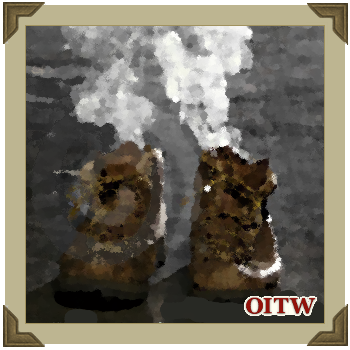
Yeah, the many multitudes of Orcs who were drawn unto his cave by the might of his explosion found but four remains of that most Holy Orc. His head, his right thumb, his left thigh bone, his right foot , yeah but also his ear trumpet that he had fashioned himself from the wood of the chip tree and his boots which were smoking.
These the good Orcs of Shirewood gathered and took them unto the Abborc of Lentil who proclaimed the Wholly, Holey, Holy Orc a Saint and bad the remains be placed within a casket of gold. This was displayed unto pilgrims once every year on Saint Labyrinthus`day, the thirty second day of Orctover it being the day of the year on which the Blessed Labyrinthus was taken unto Sentinel by the Holy Explosion.
So the gifts of the pilgrims made the Abbey, and the Abborc, of Lentil very wealthy. News of this great wealth came unto the ears of King Hungry VIII who, having six wives and with Cryptmass approaching was much troubled by the cost of the presents that he would have to buy them and his Royal sproglets and in-laws. Had not his wars and extravagances emptied the Royal piggy bank!
Then did his counsellor Tummyus Crumwell suggest that the wealth of the Abbey of Lentil could be better employed if it belonged unto His Majorcsty.
Lo, in his power did King Hungry declare that all the wealth of all the Abbeys in Albion were now his. This made the Abbott of Lentil most verily miffed, especially when the soldiers of Hungry hanged him for being very naughty. Thus the Abbey was demolished to sell the stones of the walls, the tiles of the floor, the lead of the roof and glass of the windows until it was as if the Abbey had never been.
The gold and treasure was laid before the King who was mightily chuffed as his piggy bank flowethed over.
“Yea!” he declared unto his court in his pride, “Huzzah and Woopsiedo! Let us party!” and they partied.
Of the relics of the saint, they told that they were lost, all save for the ear trumpet that was sold, they say, along with the wood of the doors and pews as firewood.
Yet Orcs do tell that the four parts of the Wholly, Holey, Holy Saint were taken by night by four Orcs who had once been monks but were now weekly making their way unto the centre of jobs in Beesdone to perform the signing on. The Holy Smoking Boots were placed upon the feet of the eldest of they who had once been monks.
The Parts of the Body of the Saint were hidden in four secret places within the depths of Shirewood in the hope that one day they might be restored unto a new resting place and the one who does so will be granted great power.
In His time Sentinel called the monks to his side until there was but the eldest one left, spared by the power of Smoking Boots. On his deathbed, he, Timbo Gissajob, passed the Boots and the Secret on to his son who passed on these truths down through the generations unto this very day. This knowledge now resides with “Nutty Burt” of Broomcoat who nobody believes and so he wanders Shirewood alone, the Holy Smoking Boots still smoking.
Now, the Archbashup of Cantabidey has decided that a search for these relics should take place and that they ought to be in Cantabidey cathedral. Not that he really believes that they have any power but because other folk do.
The Bishop of Napoly wants to put them in his cathedral. “Santa Labyrinthus ee a good Toada, no Orc!”
The Bishop of Noportoe thinks that Saint Labyrinthus was a Goblin and really should be restored to his church in AlGarvey.
“Non!” says the Bishop of Nostradamus in Lyonesse. “Zee bones should be `ere! Hey hon!”
The Catalucians want him, arguing that he was a Dark Elf.
“Nein!” say the “Dwarves,” He liffed in eine cave vot he dug. He vass a Dwarf. Handes hoff!”
The Dog nations are always interested in old bones so they claim him too.
Even the K.G.B. of the Witchlands want to get their bony fingers on the relics. “Yess, I vonderink vat vould happen if we gave them to Doctorov?”
The rabbits of Burrovia swear that Labyrinthus was a bunny he dug a burrow, and that his power will regain their independence.
The Jock O'Bite rats, The Taffsea Notionalists and the Guinelean Republicans all claim him as one of theirs.
The only thing that is really known about his origins was that he wasn't of a giant race so Ogres and Trolls have no interest in him. He only had two legs so the Centaurs aren't bothered, the H.E.V.C. don`t see a profit in it and the Werewolves are too busy.
Otherwise just about every power on Valon seem to have a reason for claiming the relics of the Saint. The biggest one being that if there IS anything in the story they don't want anybody else getting them all. So even one relic denies the others a full set. As a result small groups of soldiers from various states have secretly made their way into the darkest, remotest part of Shirewood (where usually only Nutty Burt goes), in search of a load of old bones.
The Playing Area
A six foot by three foot table should do.
A river crosses the area from the mid points of the longest sides. In the centre of the board is a bridge.
There are six “locations” on the board, three north of the bridge and three south of it. Each is given a number from 1 to 6. 1, 2 and 3 are in the north, 4, 5 and 6 are in the south.
The Locations are placed on the board as follows:
1. On the North bank of the river on the West side of the board.
2. In the middle of the North side of the board.
3. On the North bank of the river on the East side of the board.
4. On the South bank of the river on the West side of the board.
5. In the middle of the South side of the board.
6. On the South bank of the river on the East side of the board.
Or they can be put anywhere you like really!
The Locations
1. The Gingerbread Cottage.
2. The “Scary” Tree.
3. The “Dreadlock Stone”.
4. The Old Graveyard.
5. The “Faerie” Hill.
6. The “Nasty Wood.”
The areas between locations should have a few rocks, trees and bushes placed around to give the impression of a sort of wilderness. The details of the Locations are described later under Reaching a Location.
The Relics
Six cards should be made out, 2 are left blank and the other 4 should have which “bit” of the Saint the party has found written on one side. This can be important if no one player ends up with all of the remains of the Saint.
Basically the bigger the bit, the more “Holy Points” it is going to be worth when they get it home: Head 8 points, Thigh bone 6 points, Foot 4 points and Thumb 2 points.
The cards should be shuffled and a card placed face down under the model of each location or, if preferred, in envelopes marked with the name or number of the location.
The Search Parties.
The search party comprises 1 officer, 1sergeant and 2 rank and file infantry (3 for weaker races like Goblins). They are armed as per the models used. Each one is allocated a number. The officer is 5, his sergeant4 , private3 , and the other private “grunt” 2. With Goblins and weaker races, a further “under grunt” 1. This number is used to register which member of a party is carrying a relic or relics. A member can carry any number of relics, but it is a good idea to spread them around in case a casualty is looted by an enemy and the relic/s he was carrying taken. It also points to who will be affected if Nutty Burt is “miffed” with a party and in calculating winning points at the end.
Starting Positions.
Teams start in the corner of the board of their choice. Only one team to a corner. If there are only two teams then one starts in a Northern corner and the other in a Southern corner.
“Nutty Burt”
The power of the secret is so great that it has been just a trifletoo much for Burt to cope with. Being a Broomcoater nobody believes a word of what he says. They don`t half tell some whoppers, especially down at the White Liar Tavern! He has gone totally bonkers and roams the most remote region of Shirewood. He has gone happily nuts! Now he wanders from place to place with a great big happy smile and will drop hints to anybody who asks him about the relics. But of course. Nobody bothers to check because, “Well he`s just Nutty Burt from Broomcoat. I blame the Ol` Brainsmasher that he used to drink down the “Liar”, rotted `is brains I recon! Any`ow, you know yer can`t believe a word they Broomcoaters say!”
Nutty Burt moves 2xD6 inches in a straight line each move in a direction decided by D8. He moves at the start of each turn.
1 - North
2 - North East
3 - East
4 - South East
5 - South
6 - South West
7 - West
8 - North West
Nutty Burt (I use the Orc Chaplain LE model, but any figure will do if you haven`t got him) has certain special powers that the Secret and the Holy Smoking Boots have given to him.
1. He is immune to the effects of locations and terrain. He passes through them without any penalty.
2. He can walk on water so does not need to use the Bridge
3. The bridge guard always lets him pass if he does cross the bridge.
4. If Burt throws double 1 for movement he sands still for 1 turn.
5. If Burt throws double 2, he stands still for 2 turns.
6. If Burt throws double 6 he vanishes in a puff of nice coloured smoke (A coloured cotton wool ball does the job very well) and he instantly reappears in a corner of the board determined by the roll of a D8.
1 or 2 - North East.
3 or 4 - South East.
5 or 6 - South West.
7 or 8 - North West.
7. If a search party attacks Burt he becomes “miffed” with that party and instantly vanishes in a puff of foul smelling smoke (A cotton wool ball will do for this too. A bright green ball looks better than a pink one for this). The senior member (highest number) of the attacking party will also vanish ! He reappears immediately in a corner of the board decided by D8 roll as per the above chart. Burt remains invisible for 1 turn because he hates unpleasantness and needs to get over his “mifftyitis”. He then turns up in a corner determined as above. Burt is a forgiving sort and doesn't bear a grudge so will still talk to a party that may have tried to attack him when he returns. He's invulnerable, the power of the secret protects him anyway. If his move takes Burt through a spot where search parties are fighting he vanishes as above but no search party members are moved.
Attacking Burt may seem a daft thing to do but it can be a way of moving him if another search party is getting close to him.
Any thought of attacking him in order to steal the Holy Smoking Boots is definitely a non starter. Would you want a pair of nimptyboo-hand boots that eternally smoulder, are full of Holy holes and are about twelvety hundred years old? Phew!
Finding the Relics
The aim of the game is for a search party to collect all or as many as possible, of the relics and return with them to their starting corner.
In order to commence the hunt a member of a search party must be in base to base contact with Nutty Burt. A D6 is rolled and the number gives the location of where a relic might be found and the secret of how to find it when they get there.
1. The Gingerbread Cottage.
2. The “Scary” Tree.
3. The “Dreadlock Stone.”
4. The Old Graveyard.
5. The Faerie Hill.
6. The Nasty Wood.
The team member that has been in contact with Burt then must be in base to base contact with the commander or senior member of the rest of his search party to communicate the information. In other words there is no telepathic communication if, for example, a search party sends one member of their group to talk to Burt while they go somewhere else. If the model that has been in contact with Burt is killed or otherwise can not return to base to base contact with the senior member of his party, such as getting just a little bit killed, another member of the search party has to be in base to base contact with Nutty Burt to get the location (The same one as already given to the recently deceased) and must report back (base to base contact) to the most senior member of the rest of the party.
Burt will not give another location to a party once he has given them a location to search until they have been to that location, searched it and reported back to him, or if the original “messenger” was unable to deliver the clue. Burt does like to know if his information was correct. Likewise he is ever so sympathetic if you have lost a comrade before he could deliver his message. Burt was never good at multitasking and presumes that everybody else is the same. “One job at a time will do nicely” he says.
(It`s best to stick close to each other to get the message, less chance of a messenger catching a rather nasty case of death a little sooner than he might have wished).
If on reporting back Burt throws the D6 and gives the party a location that they have already searched, just remind him that you`ve already been there. He won`t mind at all and will be only too happy to keep on rolling 'til he finds you a new one. He may be stark raving bonkers, but he`s nice, stark raving bonkers.
If a party arrives at a different location on the way to or from the location given by Nutty Burt they may not search it because they may think a relic might be there but Burt alone knows exactly where about it is and, more importantly how to get it. Anyway doing that would make Burt ever so, ever so, miffed with severe mifftyitis and he might just banish each member of that group to a different corner of the board, and the lowest ranking soldier onto the bridge . Gosh and he'll almost certainly get really horridly murdellised by the guardian of the bridge so don't do it because it's really, really naughty!
However if the party really wants to try they must throw 2xD6 and if they score 10, 11 or 12 they can search the location without fear because Nutty Burt hasn't seen, otherwise there is a flash of lightning, a roll of thunder lots of nasty smelly smoke and the party find themselves split up, each party member in a different corner. The other player/s or the GM can choose which model goes to which corner and the lowest ranking one goes to the bridge where, if it is occupied by a guardian at the time, the poor wretch will be horribly, ooh and I do mean REALLY horribly, mangled, murdered, torn to shreds and otherwise seriously inconvenienced! He is definitely deaded for all time and no doubt about it. Would any search party leader want that on his conscience! Maybe a dastardly one wouldn`t care, but you`re not like that, are you?
Reaching a Location.
Whahay! The party has got to a location!
The models (you don`t actually need models, you can just write them on a bit of card) of the locations should be put on a circle of card about 6 or 7 inches diameter. This means that the relic card underneath can`t be seen by other players. This card represents the area influenced by the location. This all will make sense in a bit. A small plate (I use green paper plates for the location areas, it gives the game that “really serious game” look). When a model comes into base contact with, or moves on the card “area” the whole search party is regarded as having reached that location and is affected by it.
If a member of the search party is a “long way away” eg. Has been “zapped” into a corner away from the party then of course they aren`t affected. (Common sense really).
Reaction
When a party is at a location it “reacts” to it (or vice versa). This happens before the search can take place. Reaction takes place in the turn in which the party makes contact with the area. Look at the list of locations and follow the “destructions”.
The Gingerbread Cottage
Built of pre-stressed gingerbread and designed by the brothers Grime this is the ideal residence for the more traditional witch.
Throw 1xD6.
1. “The Witch is out”. In her absence lowest ranking of your party starts to eat the cottage, “Aaargh! Poison!” you lose that member. Serve him right, eating a person's home is naughty!
2. “The witch is out”. So one of your party starts eating the cottage. “Yum! It's really good!” The cottage can restore up to 4 wounds per party (ie 1 model regains 4 wounds, or 2 models 2 wounds each or 4 models 1 wound each etc. ) It can do this only once per party. People really shouldn't build edible houses!
3. “What a nice old lady!” The witch gives you the relic. Look at the relic card. (If it`s a blank card what she`s given you is one of the umpteen “Lucky Pinkies of St. Swindle” which is worth 1 point. There's as many pinkies as there are players but only one per player).You can move on next turn without spending time searching.
4. “Go away! I`m busy!” The witch is in a bad mood. Move the party one inch away from the area and try again next turn, she might be happier!
5. “Can you do a little old lady a kindness?” The witch asks you to take the bridge guardian his lunch basket. This allows you to cross the bridge without having to battle the guardian(s) once. “Fank U for fetchin me lunch mates”.
6. “Oh, well I suppose if you have to”. Search as normal next move.
The Scary Tree
This tree is really, I mean REALLY scary! Throw 1xD6.
1. “Aaaaaaaaaghh!” The lowest ranking member of your party is scared to death. Sorry, he's dead.
2. “What`s this?” The party find an old ear trumpet. Throw 1xD6 on a 1-5 “Ah just some old junk, chuck it away!”. On a roll of 6 “It`s the ear trumpet of St. Labyrinthus!” Heavenly music and a bright beam of light bursts from behind the clouds. Keep it. It`s worth 4 points! (only one per game).
3 or 4. “Run Away!!!!!!” The party splits up and runs to different edges of the area. It takes 1 turn to recover and regroup. They can search for the relic in the following turn.
5 or 6. “Hah! What`s so scary about a tree!” The party may search immediately and move on next turn. “Who said Hoom Hom?”
The Dreadlock Stone
This twenty foot high anvil shaped rock is a source of Wylde Magyke and jolly powerful. Or so they say in Broomcoat. Throw 1xD6.
1. “Guiseppe woz ere” The lowest ranking party member starts scratching graffiti with his bayonet. Phoum! Big puff of smoke and he ends up in the North West corner of the board. He jolly well deserves it, the vandal!
2. “Disko Fever!” The whole party is suddenly seized by a great desire to gyrate, pulsate and generally “get down and get it on” cavorting and dancing wildly in an abandoned fashion around the stone, in honour of the Goddess Disko, for the next turn rather than search. (GM note. A copy of “20 Disco Greats” {is that possible? Are there any?} can be a useful accessory at this point).
3. “Blessings of the Great God Rollo”. Rollo, the God of dice rolls grants you the power of 1 free re-roll in the game at a time of the player's choice.
4. “Beam me up Mr. Nutty”, the party will be magykely transported into base to base contact with Nutty Burt immediately after they have searched the area.
5. Mystic Mog predicts “Dreadlock, fair, cooling later, elsewhere, bloody awful”. Bad weather, rain, fog, snow, hails of frogs, tempests, pestilence and other stuff affects the rest of the board which means YOU get a free extra move after you've searched while everybody else can't move doing whatever it is they're doing, ie. fighting, searching etc but not moving around the board. Nutty Burt still moves because he has the Holy Smoking Boots on. He likes Mog, she's nice!
6. Bottle of “Old Brainscourer”. A regular from the “White Liar” has left a bottle of this magykal ale. It can be used only once to restore up to 3 wounds in one soldier, 2 wounds in one soldier and 1 in another or 1 wound in three soldiers. It must all be used at the same time because it goes off quickly. The bottle is worth 2 points if it is not used at the end of the game.
The Bridge
Though not a location as such, search parties still have to react because it has a “guardian”. This takes place as soon as a party attempts to cross the bridge. A team that is taking the guardian its lunch can cross freely once. Likewise a party that has the Basket of Faerie Cakes may pass over without reacting once.
The bridge is usually guarded by something very horrible. If you are lucky the “guardian” may be quite reasonable, have had to go for a toilet break or be very pleased because you have brought it food.
Otherwise the search party may have to fight it. Yes, you guessed, throw a D6.
1. The guardian is in a stroppy mood. The party has to persuade it that they really have a good reason for crossing the bridge. The party has to wait a turn while he mulls it over, then may cross.
2. Toilet break, the guardian has gone for, well you don't really want to know. The party crosses unchallenged.
3. “What's it wurf?” To go across the bridge you must surrender a member of your party to become a snack for the guardian.
4. “Found this unda the bridge mate”. The party may cross the bridge and are given a present, the “Wassname” nobody knows what it is but it`s worth 2 points if you get it home. The party crosses unchallenged.
5. “Uh oh!” The guardian has decided that you are not the type that he wants going across his bridge! As a magykal being he does not conform to normal “stuff”. Your party must take him on in combat! The guardian has 12 “guardything” points. To fight him the player must take the number of members in the party and add 2xD6 to it. If the player`s score is above 12 then the guardian lets them pass. If not they have to try again in the next turn.
6. Woopsiedo! The guardian likes you! He gives you a free pass to the bridge which you can use for the rest of the game. (There are enough for all players, he's a nice chap when you get to know him).
OPTIONAL RULE: The Guardian is a Troll or an Ogre armed as per a Troll or Ogre model that you have (or any other model you want to use). Combat as per standard Flintloque rules. If the Guardian is killed a replacement will leave the Beesdone “yob centre” (A.k.a. “Stinky Sid Personnel”) which is located in the North West corner of the board at top movement rate. The bridge is unguarded until he gets to it.
The Old Graveyard
Well we`ve all seen those zombie films! “Uuuurgh!” Th...row a, urgh, D siiiix urgh! Fle...sh...must eat...hungreeeeee!
1. Gosh, what interesting gravestones! Nothing happens, search next move.
2. “It's beginning to look a lot like zombies!” Undead creatures begin to crawl all over the place. Yech! Witchland search parties are not affected, they spend the move having fun with old friends but miss a turn socialising and get 1 point for telling their relations back in Moskova how they are. Other groups must fight them off. This isn't difficult because the zombies aren't terribly bright. Throw 1xD6. If you roll 4, 5 or 6 the zombies are banished. Roll 3 and the battle continues for 1 move, roll 2 and you lose your lowest ranking soldier. If 1 is rolled then the party deducts 1 wound from every member.
3. Amazing! If the party has lost any members the lowest ranking one is restored to life with all his original points! Huzzah! He does look a bit funny mind.
4. “Hungry!” Witchland parties decide that poor Boris has to go into the cooking pot. They loose the lowest ranking member. (Oh but he tastisky good!) All other groups are unaffected, but do feel a bit peckish.
5. “Gosh! Look what I`ve found!” No, it`s not what you are looking for but it is a bone! Any party that is from a dog nation may keep it. Only one bone per player, and only dogs may claim 1 point for finding one.
6. Total respect. The party recognises that they are standing on the burial place of those long gone. Sentinel restores 1 wound to any member of the party who have suffered wounds.
OPTIONAL RULE: As well as the above throw 2xD6. If a double is scored the party gains a zombie “under grunt” as a new member. Counts 1 point if he suvives. Only one Zombie per customer please!
The Faerie Hill
This is a low circular hill where they say the faeries live, dance and do the things that faeries are supposed to do, whatever that may be. Guess what, throw a D6!
1. Uh oh, the faeries don't like the look of all your nasty guns and things. “Go away!” Try again next turn.
2. The faeries want you to do them a favour. Please take these Faerie cakes to the guardian of the bridge. He will let you cross but only once. You can search for the relic next move.
3. “Flower Power”. The Party is suddenly feeling very relaxed. The flowers seem to give off essential oil scents. Hey, let's not be negative. The party realise how much they feel for each other and the whole of Valon. The officer tells the rest of the party to call him “Flower Child”, yeah, groovy. I love you guys! Let's give everyone a big hug! Like wow, so if you miss out on a move, is that so heavy? (GMs may wish to play “Enya plays Metal” or “Ozzy Osbourne`s Easy Listening Classics” at this point). The party relaxes and does nothing other than bonding with each other and getting very relaxed. Any wounds are restored to all members of the party. Hey!
4. The party is suddenly seized with a desire to start jigging around with their arms tight by their sides! Oh no, an attack of Moikulflatlulance! (Note to GMs, “Riever-dunce” is ideal music for this).
5. The faeries like you! “Please take away this nasty, yucky thing!” The party does not have to search for the relic and may move on with it. If there is no relic then they get a bag of “Pixie dust” worth 1 point. This is of no use at all but it does make you feel a bit funny if you sniff it. (one per player).
6. The lowest ranking member of your search party has caught the attention of the very, cor, I mean,very, whahoo, attractive faerie, Gladragdriel. Throw 1xD6. If the score is 1 he has gone to join them and is lost forever. Otherwise he stays with the group but spends the rest of his life asking himself “what if?” (Twit!)
The Nasty Wood
Some woods are nice. Bluebells seem like a mist beneath the trees, sunlight glimmers green through the leaves. Red squirrels and bunny rabbits play. This is not one of those woods! This is a thick, tangled, thorn filled wood where even the Big Bad Wolf would fear to tread. Throw a D6.
1. “Waaah!” The lowest ranking member of your party legs it! Desperate with fear he runs to the nearest corner of the board and will not leave until the party is clear of the woods.
2. “Tanglewood Tales”. The search party get caught up in thorns, briars, brambles and nettles. It takes a full turn to untangle themselves. GMs may wish to have some calamine lotion on hand. Rabbit parties ignore this reaction and search as per normal.
3. “There had to be one somewhere!” You find an unusual orange and light blue metal cylinder with “Irn-Bru” written on it. If consumed just before a fight the whole party get +1 melee (if Joccians +2). It can only be used once. If the “Bru” has not been drunk by the end of the game it is worth 2 points. (3 for Joccians. It's priceless really).
4. “Where's little Luigi?” The lowest rank member of your party has vanished! “Luigi! Where are you?” You may either spend a turn searching for him (throw 1xD6, on a 1 to 4 you find him, on a 5 or 6 he`s lost forever) or you can be a right rotter and leave the poor little fellow all lost and alone. Ahhhhh!
5. “Call these woods ?” You're tough guys, these woods don't scare you! Go straight to the relic, no need to wait 'til next turn.
6. “Oops! Did he say left or right at the tree that looks extremely scary? Half of your party (lowest numbers) wander off in the wrong direction and end up 3 inches North of the wood. They can not rejoin until after the others have searched next move.
Having reacted the next turn starts with the Search for the Relic. Remove the card from under the location. If it`s blank replace it. If it is a relic, make a note of it and its value then replace it face up so that other parties know it`s gone.
After the search you take your turn as normal.
“Nicking” Relics.
Parties can “nick” relics from other parties by combat. Shooting and melee are as per normal Flintloque rules. If a member of a party who is carrying a relic or special object (The “Irn-Bru” or “Faerie Cakes” etc.) is killed, the first model of either side to come into base contact with the body (the model lying on its side or a card marker about 25mm square (a spare base?) can take any objects that the corpse has on it. This counts as an Special Action.
The End of the Game
This can be when there is only one party left alive, all four relics have been found, one party has all four relics, a specified number of turns have passed, a team returns with its relics to its starting corner, the players are about to murder each other or the GM, dawn is breaking, the house is on fire, World War III breaks out, or the “Trump of Doom*” has sounded.
(*A.k.a. “The Great Explosion of St. Labyrinthus”).
Points
Each party totals up its points for surviving;
Officer 5, Sergeant 4, Private 3, Grunt 2, Under Grunt 1, Additional Zombie Grunt 1.
Adds the relic points;
Head 8, Thigh Bone 6, Foot 4, Thumb 2.
And any other bits and bobs they may have acquired;
Pinkie of St. Swindle 1, Ear Trumpet of St. Labyrinthus 4, Bottle of “Old Brainscourer” 2, Bone (Dog parties only) 1, News for home from the Zombies (Witchlanders only) 1, Pixie Dust 1, Irn-Bru. 2 (3 for Joccians).
GM points.
The GM may award points to players for overacting when reacting to locations, dancing in a suitable manner when suffering “Disko Fever”, “Moikulflatlulance” or “Flower Power”, actually eating the Gingerbread Cottage, suitable bribery and corruption, free drinks etc. as he or she sees fit.
Highest number of points wins. Huzzah!
Other Options
If all this isn`t madness enough, then you could include,
Random Encounters
Each turn the GM or one of the players rolls 2xD6, if a double is scored a Random Encounter happens to one of the parties. Decide by D6, highest gets the encounter. Roll 1xD6.
1. The Great Whistling Chumbleygook! “What`s that strange whistling noise in the undergrowth? Aaaaaaaaaaaaaargh!” Party scatters 6 inches in all directions. You really, and I do mean really, don't EVER want to meet HIM! Nobody who has ever seen him has survived. I know it's true, the bar-Orc of the “White Liar” told me!
2. The Were-Chicken of Beesdone. (One of those fluffy chick cake decorations serves well for this). The Were-Chicken can only be killed by a silver bullet. Sensibly all party members that are carrying guns have 1 silver bullet each. Fire and miss, you've spent that bullet. Any successful shot kills the beast. (“SHAME!”) If the monster comes into base contact with a model it pecks causing 1 wound. After 1 round of combat the Were-Chicken races off into the undergrowth and can not be followed.
3. “The Talisman of Armajualpadillo”. This takes the form of a small golden Armadillo medallion on a chain. This may be worn by the leader of a party and allows free passage at the bridge. Beware, however. If the bearer of this most precious object visits the Dreadlock Stone he will rip open his jacket and shirt, suddenly acquire an embarrassing moustache and side-burns, a golden tan, a hairy chest and suffer an extreme fit of “Disko Fever” for 1 turn while the rest of the party try not to look, it`s just too horrible! “Night fever, night feeverrr!...........”. The Talisman is worth 4 points, but if you encounter “Uncle Rogipoos” he will give you 6 points for it.
4. “Hey you! Seen oor Bru anywhere?” 3 Joccian rebels who got lost during the “Furty Five” and have been wandering around the forest searching for their “can” of Irn Bru. Each is armed with a sword. Any party with the “Bru” may escape attack by giving the rats their “Bru” otherwise they will attack immediately. They automatically attack other parties because they are “Mad fer it! Gimme the Bru!”
5. Uncle Rogipoos and Jose. Your party encounters a very jolly chap with... it looks like... no, it`s vanished... oh there it is again... an armadillo. If you have the “Talisman of Armajualpadillo” he will give you 6 victory points for it. He also has a small flask of “The Big Nurse's Jollop” (Looks like honey, smells like honey, tastes like drainpipe!). This restores 1 wound to each member of a party that has been wounded. Splendid!
6. Mystic Mog. You find a very pleasant middle aged lady collecting interesting “`erbs an` useful stuff dearie,” . Be nice to her! In return she will give you (throw 1xD6) a presi!
1. “Does yer good luvver!” This is a flask containing a potion that restores 1wound up to 3 times. If unused it is worth 3 victory points, deduct 1 point every time it is used .
2. “Faerie resistance powder”. Your party can go straight to searching the Faerie Hill if they go there without having to react. If unused at the end of the game, value 2 points. “Faeries can be funny things ifn they don`t know ee. Just throw this about dearie”.
3. “Chainsaw root” This allows a party at the “Nasty Wood” to avoid having to react. Chew this and your hands become as hard and sharp as steel and you can cut through undergrowth easily. It can not be used in combat. Mog “Don`t relly go along wi` wars as a rule m`dear”. It also negates the effect of the “Scary Tree”, it`s scared of you! You can not harm the tree but you can go straight to search. The root may only be used once. Value 2 points.
4. “I`ve got a letter for my friend Vera who lives at Gingerbread Cottage. Would you be a love an` drop it off for me?” If the party takes this to the witch at “Gingerbread Cottage” they don`t have to react to the location and the witch will give them the relic, if there is one, two “Pinkies of St. Swindle” (value 1 point each), a nice cup of tea and assorted really yummy biccies. What a nice lady! Possession of the letter allows the party to cross the bridge once but only as long as the party is travelling from the South bank to the North. If, the party do NOT deliver the letter it is worth nothing (anyway, reading other people`s mail is NOT NICE!) They will also lose 6 points at the end of the game.
5. “Shirewood, fog patches clearing later”. Mog gives you a bottle full of cloudy stuff. This can be used once. If opened it causes dense fog which affects every other party but not yours. You may move at normal rates whilst all other groups get lost and move 1xD6 inches in a direction decided by 1xD8 , 1 being North then going clockwise as per “Nutty Burt`s” movement. If this results in a party going to the river they stop at the bank having got jolly wet feet. If unused it is worth 4points.
6. “You got a lucky face luvvie!” Mog gives you an amulet with a picture of a pumpkin on it. This allows the wearer to be struck or shot once and suffer no wound OR re-roll a dice throw once. If unused it is worth 3 points.
Author's Note
The author disclaims any liability for loss of sanity, family, property, money, friends, dignity, or body parts during the playing of this scenario.
~
Webmaster's Notes
An Orcs in the Webbeoriginal! The Relics of St. Labyrinthus was first GM'd by Roger back in 1976-1977 as a fantasy scenario. After summarising it on The Notables Yahoo Group (Message 1133 in fact) Roger thought it would make a great Flintloque scenario and agreed to write it up for inclusion here on OITW as it's 2010 All Hallow's Eve scenario! The nature of the scenario actually means it would work with any gaming system so if Flintloque's not your game, give it a go anyways.